Green Zone is the latest exercise in shaky cinematography from Paul Greengrass, one of my favorite directors today. Greengrass is one of the few filmmakers who can dramatize political issues using a pop culture style (somewhat like Charles Dickens). He starts a movie, grabs you by the throat and won’t let go, using racial unrest and government cover up (The Murder of Stephan Lawrence); the conflict in Ireland (Bloody Sunday); terrorism (United 93); and intelligence corruption (the Bourne movies) as his bailiwick. Green Zone is true to form as it is a fictionalized (to say the least) look at how the U.S. got into the war in Iraq and then got hoisted by its own petard. But in the end, though the movie is entertaining enough and I was never bored, it never really satisfied. This may be because as visual a stylist as Greengrass is, Green Zone may actually demonstrate the downside of considering movies mainly a visual art form. Having a visual style and an ability to tell a story in visual terms is fine, but it can only do so much when it comes to characterizations and creating interesting and exciting plot twists and turns. One way to demonstrate this is by comparing Green Zone to In the Loop, also a political diatribe, but with a black comedy approach. In the Loop is about the petty conflicts and furious wrangling leading up to America and Great Britain’s entry into the Iraq war. But it has the same conceit as Green Zone: in In the Loop, just as one comes to think that maybe, just maybe, a war with Iraq can be avoided, we realize that, no, it can’t, because in real life, we went to war with Iraq. In Green Zone, it’s about the search for WMD’s and the truth behind an intelligence source and the idea that if only the truth could be revealed in time, the future of Iraq could be different; and as In the Loop, the audience for Green Zone already knows the truth, they know that the there were no WMD’s and the intelligence source was fabricated and that the “good guys” lost. But while In the Loop grabs us emotionally even though we know the outcome, Green Zone leaves us a bit hungry and unsatisfied. And the reason seems to be that while Green Zone is beautifully directed, the screenplay by Brian Helgeland has characters that are bland and not that interesting and the plot is filled with twists and turns that lack surprise (with an ending that is just a bit too pat to work). In contrast, while In the Loop has the somewhat bland look of a TV show (which it is based on), the characterizations and dialog are so brilliant and the constant farce inherent in the twists and turns so surprising, we can’t help but become emotionally involved and even devastated when the truth, something we already knew, is revealed. The movie stars the square jawed Matt Dillon as the hero; Greg Kinnear as the oily bad guy; and Brendan Gleeson (struggling with an American accent) as the intelligence officer not intelligent enough to outthink Greg Kinnear (not something one would want to put on one’s resume). They’re all fine, but can’t do much with what they’re given.
The Ghost Writer is the latest film from Roman Polanski, also a political thriller, but a bit less frenetic; in fact, it’s as soothing as a Budhist retreat in comparison. In it Ewan McGregor plays a down on his luck author hired to ghost a former British Prime Minister’s (Pierce Brosnan) memoirs after the previous writer (a long time assistant and faithful friend to the PM) is found dead from drowning, an apparent suicide. The basic premise of this story, that the PM’s wife is a CIA operative who actually pulled the strings of her husband’s actions, might have worked well as a dark comedy on the level of Dr. Strangelove and The Loved One, but as a drama, it’s a bit hard to take seriously. The screenplay, by Robert Harris and Polanksi himself, never makes the whole back story believable, though they do provide some of the drollest lines in movies of late. The movie itself, though it has its pleasures, starts out a bit slow (possibly because McGregor never solves the mystery so much as stumbles onto various clues, each discovery of which takes a lot of setting up). It’s not until McGregor drives his predecessor’s car and the GPS leads him to Tom Wilkinson, a slithery professor who claims not to have known the PM and doing such a convincing job of it that one knows he’s lying, that the pace picks up. Wilkinson and especially Brosnan, showing what his career could have become if it hadn’t been sideswiped by Remington Steele and James Bond, give the best performances in the movie. Everyone else gets the job done, though Kim Cattrall doesn’t have the most convincing of English accents (Wilkinson doesn’t have the most convincing of American, but he manages to rise above it). The ending never quite made sense to me. It wasn’t clear who put the code in the book (was it the previous ghost writer or the PM, either choice of which comes equipped with their own set of holes in the plot) and it has one of these codas where the hero has a choice: call the media and the PM’s political opponents and tell them the truth, or reveal it to the one person who can have you killed. Guess which one he chooses? And then he gets killed in a way that can’t guarantee a person would be killed (hit and runs, though visually shocking, aren’t as certain in their results as this movie would have you believe). The movie looks good, with its bleak, film noir cinematography of grays, and the effective music by Alexandre Dusplat adds to the tension, but the story never really works. There’s also an odd subtext to the film. The British, at least in such films and TV programs as Love, Actually, The State Within and The Girl in the Cafe, have often held themselves up as the moral arbiter of the world, a righteous country often checking the U.S.’s rash political policies. Here, the idea is taken one step further: maybe England didn’t take the high road in the war on terrorism, but it wasn’t their fault; the PM’s office was just an extension of the America CIA. This might be a frightening idea if the British hadn’t chosen an organization to blame that couldn’t even kill Castro when it wanted to.
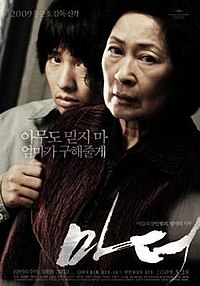
Mother is the latest from South Korean filmmaker Joon-ho Bong who gave us the monster movie The Host and the movie about a different sort of monster, Memories of Murder, which revolves around the search for a serial killer.Mother is not far off from being a monster movie itself.It’s about a slow witted young man being railroaded in the murder of a young girl and the monstrous lengths his mother, played by Hye-ja Kim, will go to save him, even though it’s possible that even though her son is being railroaded, he could still be guilty.In Psycho, Anthony Perkins says “[a] boy’s best friend is his mother” and that is so true here as Hye-ja Kim will stop at nothing, even killing someone herself, to help her son get out of prison.The movie, and Bong’s others, may not be to everyone’s taste.The acting style is not what we in the West would call naturalistic.It’s somewhat stylized and at times over the top in the way people wear their emotions on their shoulders.But the performances are first rate, especially Hye-ja Kim (in one of those no matter how much she repulses me, I still can’t help but be on her side characters), as well as Ku Jin as her son’s supposed best friend and the one most likely to have killed the girl if the son didn’t.The plot is pretty much of a page turner and it has a wonderfully Hitchcockian moment in which Kim gets stuck in a closet and has to watch a young couple have sex, then sneak out while the two are asleep; as in true Sir Alfred fashion, one wants to look away, but then of course, the voyeur in all of us claims victory.There are a few constants in Bong’s movies so far, other than there are monsters living among us.Even more constant perhaps is the portrayal of the Korean police as hopelessly inept and corrupt (even if they get the right person, it’s by accident, not by solid procedural investigation).They’re a modern day equivalents of the Keystone Cops and I don’t think I’d want to be Bong if he’d ever has to make a call to 911.The darkly comic and riveting screenplay is by Eun-kyo Park, Wun-kyo Park and the director. One of the best films of the year so far.
An occassional listing of five favorite or greatest films with similar subject matter. This time round, in honor of Nip/Tuck's final season, five films about plastic or reconstructive surgery:
The Girl on the Train is the most recent film by Andre Techine, one of my favorite French film directors.However, by the time the movie was over, I really wasn’t sure what it was about the subject matter here that intrigued Techine.The centerpiece of the movie is an attack on a young woman on a train that she claims was anti-semitically motivated, but later turns out to have been fabricated.A fascinating subject, true; but at least for me, not a particularly fascinating treatment of it.In fact, very little of the movie has to do with the attack itself or the reason for it.There are also subplots concerning the woman becoming involved with an aspiring wrestler who starts dealing drugs to support her (the most interesting aspect of the movie); the woman’s mother (played by the ever luminous Catherine Deneuve) contemplating reviving a romance with a lawyer who was in love with her when her husband was in the army (the lawyer is played by French stalwart Michel Blanc—neither Deneuve or Blanc are particular strangers to Techine’s movies); the young woman finding a job, though she doesn’t seem particularly suited to do anything; the marital difficulties of the lawyer’s son and daughter-in law (including whether to give his grandson a Bah Mitsvah).The screenplay (by Odile Barski, Jean-Marie Besset and Techine himself) is what one might call all over the place.The acting seems fine, though one of the problems is that the lead, Emilie Dequenne had a certain Gwyneth Paltrow blandness to her; however, this may not have been her fault—her character does seem a bit lost at sea; if the writers’ don’t seem to understand what made her tick, it makes it that much more difficult for the actor.But in the end, what exactly this movie has to say about being Jewish in France (if the attempt was to say anything) or what prompted the young woman to lie (the character isn’t even Jewish) doesn’t come through.
I’ve only seen three Bollywood movies, but I think I’m really beginning to warm up to them.I’m not sure what it is.They’re sentimental, over the top, obvious and have no shame in how they try to manipulate you.But there’s just something about this lack of shame that is often what makes them work as well.I especially love their Dickensian approach, taking a social or political issue and putting it in a popular form.For Like Stars on Earth it was dyslexia.For 3 Idiots (my favorite so far), it was the high suicide rate at Indian colleges.But My Name is Khan (not a sequel to a Star Trek movie) takes the cake combining Asperger’s syndrome with 9/11, racial and religious intolerance and Katrina.Everything but the kitchen sink, which actually does appear quite often as well.It shouldn’t work.It’s too much.But again, there is just something about the over the top sincerity of it all that finally makes you just throw up your hands and go along with it.The lead is Shahrukh Khan, apparently the most popular Bollywood actor today and he is in top form as the lead character suffering from Asperger’s who goes on a journey to tell an American president, any American president, that he is not a terrorist after his little boy is killed by schoolyard bullies for being Middle Eastern in background.In some ways, the logic of the plot often makes little sense.The death of his son doesn’t happen for almost eight years after 9/11.Khan then crisscrosses America going from shore to shore with little ease and in almost no time.One day he’s in the South, the next he’s in California, a little while later he’s in New Mexico, then suddenly he’s back in the South having no problem getting to a remote town in spite of a raging hurricane.This ease of travel also applies to the other characters who all manage to show up in a small Southern town during a hurricane with no problem whatsoever as well.And the money issue is as vague as Khan’s travel plans.One day he can’t get money out of an ATM because his balance is so low.The next day he has enough to give five hundred dollars to a charity.On one hand, this stops the movie from really being as good as it could be.At the same time, this clunky structure does add a certain charm to the whole thing.The writers (Shibani Bathija and Niranjan Iyengar) take an awful chance killing of Khan’s child half way through.I thought this was just too much manipulation and didn’t think there was any way the plot could recover.But by the time it was over, I was crying my eyes out over the journey everyone went through.The politics is obvious here.Khan could never get to Bush to tell him he isn’t a terrorist.But once Obama is elected, Obama modifies his schedule to meet with Khan even though Khan really doesn’t even have to tell Obama that he’s not a terrorist, Obama knows.Change has come to America. Atleast that’s the hope.
Well, I guess I just have to say it and shame the devil. As much as I admire Martin Scorsese and consider him to be one of the greatest American filmmakers today, Shutter Island did not remotely work for me. To explain why, though, it will be necessary for me to reveal the much of the plot, so be forewarned. The story actually fell apart for me in the opening scene in which Teddy Daniels (Leonardo DiCaprio), a federal marshal, is on a ferry being taken to Shutter Island, a prison for mentally ill criminals, the worst of the worst. Just before the ferry docks, he meets Chuck Aule (Mark Ruffalo), his new partner. Just before the ferry docks. Not on dry land in an office to review the case before leaving for the island. Not even as they get on board the ferry. But as the ferry is about to dock. This is such a poor set up, so badly written, that I could come up with only one explanation for the clunkiness—Teddy is not a federal marshal, but actually an inmate of the island. Once I realized that, it was just a matter of waiting around, and waiting around, and waiting around…and waiting around until the full reason for the deception was revealed. When it was revealed, and again I must be honest and shame the devil, I found the reason so preposterous (it was an elaborate ruse to try to cure Teddy of his delusions) that it was impossible for me to take any of it seriously. To paraphrase a friend of mine (who did like the movie), either the doctors on the island had way too much time on their hands, or they are the worst psychiatrists in the history of the world. The story also didn’t make sense on another level. Teddy is called the most dangerous inmate on the island. In the end, when the cure doesn’t take (big surprise there), he is to be lobotomized. But if Teddy is the most dangerous inmate on the island, there is no way you will ever make me believe the doctors there would give him free reign (they might be able to cover up Teddy killing another inmate, but if he kills anyone else—a doctor, nurse, staff member—there goes the whole shebang). If he’s not the most dangerous man on the island, then he doesn’t need to be lobotomized. Scorsese does what he can to make the holes in the story irrelevant (script by Laeta Kalogridis). But I think he overplays his hand here. I strongly suspect it would have worked better with a lower key approach ala a Val Lewton movie. Then again, with a story line as preposterous as the one here, maybe Scorsese made the right decision. But the real question perhaps is why does Scorsese feels he needs to make movies like this anymore? Is this really the sort of film that interests him? He’s won his Oscar. Let him get back to the kind of personal films he used to make.
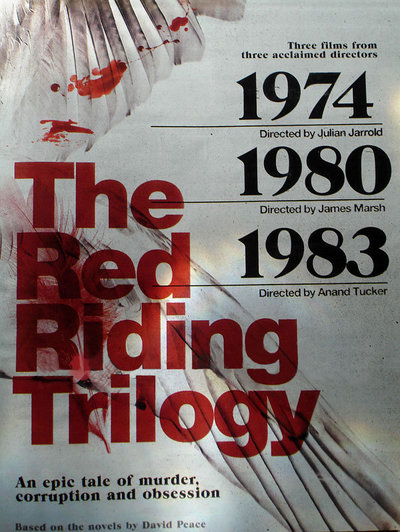
The Red Riding Trilogy is three movies, Red Riding 1974, Red Riding 1980 and Red Riding 1983. They are inspired by true events, but not the events that the previews suggest are the source. For a number of years leading up to 1980, prostitutes were being murdered by a serial killer called the Yorkshire Ripper. But only Red Riding 1980 deals in any way with the Ripper and only then in a tangential way. The real basis of the Red Riding series is the disappearance of three little girls leading up to 1974. It ended when one of the girls was found raped and left for dead; a mentally slow man was set up for the murder; and there was a shoot out at a local club that killed a local businessman who was planning to build a shopping mall in the area. Thus the abduction of the little girls ended. 1974 deals with a reporter who discovers that the real child abductor is the businessman; but the reporter is manipulated by the incredibly corrupt local police (who for some reason the businessman has brought in on the building of the mall) to kill the businessman at the club (not entirely believable; it’s one of those things that looks great on screen, but when one starts going over it afterwards it doesn’t quite gel; all I could think is how much of a chance the police were taking; what if the reporter had done the more realistic and believable action of going to the London newspapers or getting a lawyer and filing suit). 1980 does deal with the Yorkshire Ripper, but only to the extent that one of his victims doesn’t fit with the others (like that Sesame Street ditty). An out of town detective is hired to look into it and into police corruption, but only ends up getting murdered by the police in a cover up of the earlier crimes. 1983 begins with the disappearance of a little girl and the public wondering if the original abductor has returned. One of those lame lawyers who rises to the occasion is the lead here and he discovers the real truth—I suppose; I was never quite sure how it all played out and some of the details seem a bit fuzzy. Though all three movies were written by the same person (Tony Grisoni), each was directed by someone different. There is something about the grimy, depressing film noir atmosphere of the whole thing that sticks with one and makes one want to watch the whole thing. You do get caught up in it just enough to want to see that pay off, hoping that even though the story’s not making a whit of sense, it will when the third film is over. But that pay off never arrived for me. I talked about the film for about thirty minutes with a fellow theater patron who also saw all three films. We could reconstruct the plot more or less, but not in a way that we could make hide or hair of it; we spent most of our time just listing the plot twist and turns that could not be explained or weren’t believable. It’s one of those films in which the corruption is so widespread the courts and newspapers are in on it just as much as the police are. And not just the local police. The central character in the second film, a police detective, has his house arsoned in another district and no one seems to look into it. The acting is fine, filled with the top tier of the British B level thespians (the A levels are all off doing the Harry Potter films). It’s a frustrating set of movies, mainly because one so wants it to be better than they are.
The BAFTAs and WGA Awards have come and gone so now it’s pretty much over but the waiting.It’s not unusual for the BAFTAs to match up with the Oscars (they gave the best actress award to Marion Cotillard, for example, when many, including moi, expected it to be Julie Christie), even though the voting bloc only partially overlaps.I think this year, their awarding Best Picture, Director and Screenplay to The Hurt Locker pretty much seals the deal for Bigelow and company.However, I think Best Actor will not go to Colin Firth (as it did at the BAFTAs, though common wisdom had it that Firth was going to win the Oscar until Crazy Heart was rushed to an earlier release), but to Jeff Bridges.And Carey Mulligan will also not win Best Actress (as she did at the BAFTAs).That should still go to Sandra Bullock (who wasn’t nominated for a BAFTA; The Blind Side hasn’t opened in England); even if it didn’t go to Bullock, the Oscar would probably go to Meryl Streep.
The WGA awards went to the expected winners of the Oscars: The Hurt Locker for original screenplay and Up in the Air for adapted.It is true that some screenplays nominated for Oscars, like Inglorious Basterds and In the Loop, weren’t eligible for WGA awards.But The Hurt Locker and Up in the Air were the expected winners long before the WGA nominations were even announced.The Hurt Locker should now win Best Picture and Director, which means it should win the screenplay award as well.Up in the Air, which for some time was expected to win Best Picture until it peaked too early, should get the adapted screenplay as the consolation prize.
The Most Dangerous Man in America is one of the five documentaries nominated for a 2009 Oscar. I grew up during the period covered in the film and though, as a teenager in Corpus Christi, Texas, politics didn’t really interest me that much (I escaped the draft by one year), I do have memories of some of the events related in this movie. As I got older, I did come to realize that the American people were often lied to by their government in regards to Viet Nam (the attacks on U.S. ships in the Gulf of Tonkin were pure fabrication, for example). At the same time, it still never ceases to amaze me the extent to which the deception went. I don’t know why it should. One of the rather scary aspects of the film is just how much it reminds me of our involvement in Iraq and the government’s lying about weapons of mass destruction. But why should the government of the past be any different than the government of the present? Even more nightmarish, perhaps, is to realize that Henry Kissinger was actually the voice of reason in a White House that, under Richard Nixon, wanted to drop a nuclear bomb on North Viet Nam. It’s narrated by many of the people who actually took part in the events, as well as by the title hero himself, Daniel Ellsberg, still alive and still protesting. He started out as a hawk and conservative, but came to realize that the war had to be stopped and hoped that releasing the top secret Pentagon Papers, which revealed the history of the U.S. involvement in the Southeast Asia from as far back as Truman, would do just that. It didn’t, at least not directly, much to Ellsberg’s disappointment. Nixon was reelected in spite of the Papers publication. But it did put such pressure on the paranoid White House that Nixon started doing things like having people break into Ellsberg’s psychiatrist office and try to break into the Democratic headquarters at Watergate. The shame of the crimes forced Nixon to resign and end the war. Perhaps the greatest triumph of the Papers’ publication was the Supreme Court ruling allowing them to be published, which meant that just because the government says something is top secret, that doesn’t mean it should be. For those of you who like a love story, this also has that as well; there is a sweet through line of Daniel’s wooing of his second wife Patricia, an anti-war activist. You can still see the love in their eyes. This is a strong, fascinating documentary, clearly told by the writers Michael Chandler, Judith Ehrlich (who also directed), Rick Goldsmith (who also directed) and Lawrence Lerew. See it on a double bill with The Fog of War, Errol Morris’s filming of one long monologue by the former U.S. Secretary of Defense Robert S. McNamara who turned against the war after supporting it and lying about it. He also makes an appearance in the movie in old news footage where he gets off a plane after being briefed by Ellsberg about the hopelessness of the war. McNamara fully agreed with Ellsberg, but there he is, telling reporters that victory is right around the corner.
Terribly Happy has an Oscar connection as well. It was Denmark’s official entry in the foreign film category. It wasn’t chosen, however. To be honest, I can’t say I’m that disappointed. It’s about a police officer in Copenhagen who pulls a gun on his wife when he catches her with another man. For recovery (and punishment), he’s sent to a very, very, very small town that has its own ways of doing things, like killing and dumping people they don’t like in a bog (it almost reads like a very, very, very serious version of Hot Fuzz). The officer is pursued sexually by the wife of the town alpha male and bully, who often beats her for flirting with other men. This leads to tragedy for the wife and bully who end up getting killed by the officer, crimes covered up by the town. From that summary, it sounds like my cup of tea. But Terribly Happy never grabbed me. I wasn’t always sure why. I know that at the beginning the officer comes across as so incompetent I had little interest or sympathy for him. He seemed over his head, but not because the town had its own set of rules, but because he didn’t know what he was doing. The killing of the wife seemed a bit forced and unintentionally funny. And the ending where the town joins forces to stop the officer from returning to Copenhagen by threatening to tell the authorities what really happened didn’t make sense to me. I didn’t know why they wanted to keep this guy around. He’s not the most popular addition to a party. And why you would want to have someone around who got away with killing two people is beyond me; after all, the more someone kills and gets away with it, the more likely he is to kill again. And the same people who didn’t want him to call the police after the wife died because secrets of the town would come out, not seem to suddenly have no problem going to the police themselves. What would they do if the officer called their bluff? They’d be in almost as much trouble as he would. The screenplay is by Dunja Gry Jensen and the director Henrik Ruben Genz. There’s something about the unusual setting and the dark, Scandanavian mood about the whole thing that is somewhat interesting in itself. It tries to be different, character and atmosphere rather than formula directed and I wanted to be involved. I’m also willing to concede that it was me and not the film. But I just couldn’t get that terribly happy about it.
In order to post a message, either click on "comments" at the bottom of the post or click on the title of the post and a comment section will appear at the bottom of the post. All comments are welcome.