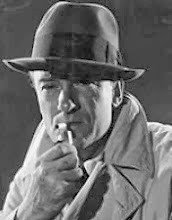
 Last week I caught the Thomas Crown Affair on TCM on demand. The Thomas Crown Affair is that chic movie about a bored businessman who in an existential crisis decides to rob a bank because nothing else amuses him. Hey, it could be worse. He could have done what Goldman Sachs did. At any rate, though I don't think the film really holds up that well, mainly because the characters played by McQueen and Dunaway aren't that vibrant or interesting (Jack Weston makes the most memorable appearance in the movie), I did enjoy the split screen techniques (cinematography by Haskell Wexler, one of the greats, and editing by, among others, Hal Ashby) and hearing Windmills of Your Mind again (a sort of Jacques Brel like song of despair that was very popular at the time). But after seeing the movie, I was talking about it with my friend Beriau. I remarked that at this time, the Hollywood Production Code was pretty much gone and people were getting away with crime now in movies like Oceans 11 (they didn't get the money, but didn't get caught) , The Sting and the Hot Rock. Beriau said it best when he said that that was because they were cool. It was the period in movies when being cool was all. It didn't matter what you did, as long as you looked good while doing it, you could get away with anything. It was the period when appearance trumped morality.
 Heartbreaker stars Romain Duris, aka (at least to me) the male Audrey Tatou. Duris is one of the major new stars of the French cinema and it’s not hard to see why. He’s incredibly attractive, in spite of (or because of) an odd jaw line that makes every smile of his a sneer and a remarkably hirsute chest (he may be aware of this since he compensates for the former by wearing a goatee and the latter by having his shirt off only once this time out, and then in dim light). In many of his films he plays men who have little trouble getting woman to fall in love and/or go to bed with him. Hey, it works for me. In Heartbreaker, he plays the title role, a man (by the name of Alex) who, with his two partners, runs a business that for an immodest fee breaks up relationships of women who, whether they realize it or not, are unhappy with their present partner. He does this by making them fall in love with him (hey, it’s Duris, of course he does), then gently and with exquisite romanticism tells them he can never be theirs, thereby avoiding having sex with them and thereby making them realize they’re just too good for their asshole significant others. Everything goes well until he overspends on Armani suits (for the fashionistas out there, Heartbreaker is also telling us that the extremely skinny look is back for men and that going barefoot is still the de jour thing to do); ends up owing 30,000 Euros to a mobster; and so has to take a job against his principals: a man of questionable background wants Alex to break up a wedding taking place in ten days between his daughter and an English financier even though there’s no evidence that the woman is unhappy. But Alex’s best laid plans go awry when he falls for the bride to be, Juliette, played by the equally lovely Vanessa Paradis. Okay, who didn’t see that coming? And, okay, okay, I know what you’re thinking. This will soon playing at a theater near you, but starring Matthew McConaughey, Vince Vaughn (well, if he could lose a little weight), or Owen Wilson and co-starring Sandra Bullock, Jennifer Aniston or J Lo. And indeed, Heartbreaker is proof that in addition to the serious, existentialist, art house dramas of Truffaut and Godard, the French lose no sleep playing to the lowest common denominator anymore than we do. Yes, Heartbreaker is another entry in that recent subgenre of romantic comedies, the chick flick with a male lead. At the same time, Heartbreaker, like many of the recent U.S. romantic comedies, is also a throwback to the 1930’s screwball type in which two people must go through a series of often ridiculous obstacles to find out that as ridiculous as it may seem, they ridiculously love each other. As ridiculous as that may sound, back then, Duris’s role would be played by Cary Grant or William Powell and Paradis’s would be played by Katherine Hepburn or Carole Lombard and, like here, would often be about a woman who is somehow superior (in breeding, riches or class) to the common man male character and the man must prove himself worthy of the woman while the woman has to come down off her pedestal. In fact, the ending here is straight out It Happened One Night; Juliette (as Claudette Colbert) is being walked down the aisle by her father when he tells her he has a car waiting for her to take off before she says “I Do” and that Alex (Clark Gable) refused his money, meaning Alex really does love her and is worthy of her. And Juliette does ditch her fiancé (played here by Love Actually’s Andrew Lincoln, a part often played by Ralph Bellamy) at the altar, for the reason that he’s boring, the only sin more unforgiveable than adultery in the classic comedies of the 1930’s. In the end, Heartbreaker is all Duris. It’s his show and he makes the most of it; he’s definitely a star. He laughs, he cries, he fake cries, he sings to George Michael; he even has a through line where he ends up dancing the climactic number from Dirty Dancing (you had to be there) as if he’s been wanting to do that in movies for years (he’s a tad stiffer than Patrick Swayze, but it’s nice moment). The screenplay, by Laurent Zeitoun, Jeremy Doner and Yohan Gromb, is bright and breezy and often earns its laughs (the funniest moment is when Alex’s assistant, the doe eyed, hang dogged Francois Damiens, whose character has delusions of being a great method actor, knocks out the party girl best friend of Juliette’s). The only thing the writer’s don’t do is give Juliette’s father a convincing reason for being against the marriage. The direction, which is also bright and breezy, is by Pascal Chaumeil. Hey, you could do worse. You could go see The Bounty Hunter or The Ugly Truth. But neither of those has Romain Duris.
 My Father’s Guests is a complicated comedy, or actually tragicomedy, written by Luc Beraud and the director Anne Le Ny. It’s complicated because it takes on the idea of illegal immigration by refusing to take the easy way out, mainly in that unlike movies like The Visitor and The Blind Side (though The Blind Side is not about immigrants, it is about bringing someone of a different ethnic background into one’s home), the person who moves in is not a nice person. Michel Aumont (who played the neighbor that convinced Daniel Auteill to go gay in The Closet) plays , with convincing empathy, Lucien Paumelle, a grand old geezer who was involved in the underground during WWII and has championed radical causes ever since. His latest is the plight of illegal immigrants, but instead of just working to help them through regular channels, he decides to put his principles where his mouth is by marrying a woman from Moldavia and moving her and her little girl into his home (one of the last rent controlled apartments in Paris, we are informed). The woman is Tatiana, played by Valerie Benguigui, a racist, vulgar sex pot who, horror of horrors, smokes (I know, I know, it’s France for god’s sake, but still, there you have it). But the real question facing Lucien’s son Arnaud (played by Fabrice Luchini, who often plays these comically uptight conservatives, and since he does it so well, why not) and daughter Babette (Karin Viard, still waif like in her 40’s) is whether Tatiana is out to take their father for all she can or is she the poster child for the illegal immigration cause. Arnaud, who has grown use to the idea that his father has never approved of him or his life, knows the answer at once: he calls Tatiana a whore, but not exactly out of disrespect; he says it as a matter of fact, not as a judgment. And after all, if his father wants to marry a prostitute, why shouldn’t he? But Babette, who has always been her father’s little girl and followed in his do gooding footsteps, wants to wait judgment before afraid of condemning someone just because they are of a different background. The movie itself doesn’t really go anywhere interesting for awhile until two things happen: the first is that it becomes clear that Lucien is having sex with Tatiana and that he is probably to some degree forcing her to do it, though from his perspective, he’s just hopelessly in love. The second thing is that about a third of the way through, it stops being about Lucien and becomes about Arnaud and Babette and there are some marvelous scenes where the two realize they have lost touch as siblings and they begin to reconnect. There is something touching and emotionally rich about these two reaching out to each other as their father continues to slip away. As the story continues, it becomes obvious that Tatiana, whether a victim or not, is bad for Lucien and is destroying his life, at one point almost killing him (though possibly by accident, but who knows, who really knows). There’s one heart breaking scene where Lucien wants both his offspring to sign papers renouncing any inheritance so he can leave it to Tatiana and her daughter; this is devastating to both, though especially to Babette, not because they are out the money (Lucien doesn’t even have that much), but because he is basically telling them he doesn’t love them anymore. At the same time, inadvertently, Tatiana causes a Renaissance in Arnaud and Babette, bringing them closer together and making Babette realize that the relationship she’s in, with a dumpy guy her age who can’t give her an orgasm, is not good enough for her so she dumps him for a younger, fellow doctor who can…give her an orgasm. But in the end, Arnaud and Babette have to betray their father by betraying Titiana and reporting her to immigration. Titiana and her daughter are then returned to Moldavia. It’s a no win situation, but it has to be done, which is why it’s a tragicomedy, with Tatiana’s daughter, a bright student who desperately needs the advantages of France, being the biggest loser. This is a movie that starts out as a slight comedy that suddenly takes twists and turns that quietly leads the audience deeper into the situation. It’s not as satisfying as it might be, perhaps because the plot is a bit unfocused and what starts out being a story about a social issue changes horses and becomes about something else, almost as if the writers lied to you. But as the same time, the effect of the movie sneaks up on you as the mood of the piece goes from light and farcical to serious and wistful. You come out moved and befuddled by the how difficult life makes it to live.
 Sphinx (or Gardiens de l’ordre), the third film I saw at the festival, is also the name of a new drug hitting the clubs in Paris. It makes one incredibly aggressive and violent and is so expensive only spoiled rich kids can afford it. Thus begins the travails of two police officers, Julie (Cecile De France) and Simon (Fred Testot), who with a third, are called to the apartment of a young man who won’t turn his Beethoven down. When the third officer gets the young man to open the door, the young man just shoots him, for no apparent reason. Julie and Simon return fire. The officer is dead, but the young man survives in a coma. Julie and Simon also find in the young man’s hands some fluorescent yellow pills, the title character. The problem is that the young man is the son of a Deputy in the French government and so the officer’s boss gets the officers to sign statements basically saying they were at fault, while their boss has all traces of the drug removed from the crime scene. If they don’t sign, they lose their job. The additional problem is that when the young man comes out of his coma, he insists on suing for police brutality. The officers now know their days are numbered. I’m no expert on the French police scene, but this is the point where an American remake would prove difficult. It’s hard to believe that any American officer would sign such a statement without first consulting a union representative. In addition, in our nation of 24 hour news, the son of a, say, Cabinet Member ending up in a coma after a shoot out with police would be catnip to their meows. FOX and MSNBC would be talking about nothing else for days. And any cabinet member who wouldn’t be able to convince their son to drop all charges of police brutality in exchange for making it all go away, shouldn’t be a cabinet member (I’m not sure I fully bought this even in this context). The officers’ only hope now is to bring down the drug dealer who supplied the Sphinx in the first place, but must do it on their own time while being assigned to desk jobs (and must do it before they are fired). This part of the movie is a tad formulaic, but it’s still fascinating. The step by step procedure the officers use to set up shop as dealers in their own right is riveting, and the way the two manage to sidestep every roadblock sent their way is thrilling. There are two scenes of sudden violence, so unexpected they leave you breathless. And the whole thing works itself out very satisfactorily with a very tight screenplay by Dan Sasson and the director Nicolas Boukhrief. De France and Testot are both very attractive and have great chemistry. And you know this is a French film when Testot asks De France if they are sleeping together and her response isn’t an outrageous “Non”, but a “not tonight”. The French may be a funny race, but their attitude toward sex, at least in their movies, could teach U.S. filmmakers something.
I often get into discussions with fellow writers over whether central characters of movies have to be likeable or not. To me it’s a ridiculous argument since there are tons of movies with not just unpleasant leads, but wholly repulsive ones. But I know someone who doesn’t want to see a movie with a central character he wouldn’t want to have dinner with. I never understood this, since for me, one of the great things about art is that I’m able interact with people I would never want to meet in real life or go to places, or become involved in situations, that I would never, ever want to outside the safe confines of the movie theater. But not everyone agrees. And two films opened recently with lead characters whom I wouldn’t, and I don’t think the someone I mentioned above would, want to break bread with anytime soon.


 The Crazies is a remake of the cult favorite by the same name originally made by legendary filmmaker George Romeo who seems to have a thing for ending the world. How closely this remake follows the original I can’t say since, sad to also say, I haven’t seen the original. But this is an effective, nail biting, edge of your seat horror movie with a sharp script by Scott Kosar and Ray Wright (from Romero’s original) and solidly directed by Breck Eisner who has taken the wise choice of letting the movie work on its own terms rather than going over the top with a show-offy style some directors would use to let the audience know just how brilliant they are. Timothy Olyphant plays a sheriff of a small, quiet, boring town who needs him as much as Mayberry needed Andy Griffith. Radha Mitchell plays his newly pregnant wife. For reasons unknown, one day, out of existential nowhere, people in the town start losing focus and fading out (like turning down the volume on the TV) and then coming back with a vengeance, slaughtering anybody and anyone they come into contact with. It spreads like a virus, which makes sense, since the cause is a biological weapon created by the government which was being taken on a plane to be destroyed; except, inconveniently for everyone involved, the plane crashes (don’t you hate when that happens). There’s one exceptionally creepy scene where Olyphant walks main street and it is eerily quiet, too quiet, even for this dusty town whose “you are now entering” and “you are no leaving” signs are back to back. The government soon arrives and starts quarantining everyone, with people who have a high temperature being segregated from those without, and the writer and director do some interesting things here in using the Holocaust as a metaphor for this round up. Mitchell has a temperature (because she’s pregnant, not because she has a virus), so she is separated from Olyphant. And the plot then becomes Olyphant and his deputy rescuing his wife and another woman and trying to get to safety. Of course, it makes no sense for Olyphant to rescue his wife since he doesn’t know what is going on and could actually be making things worse, but what can you do? If he doesn’t, you don’t have a movie. It also has some issues in that the symptoms of the virus seem to vary at times depending on the needs of the authors. But all in all, this is one of those solid entertainments that thrills, chills and fills the time quite entertainingly.
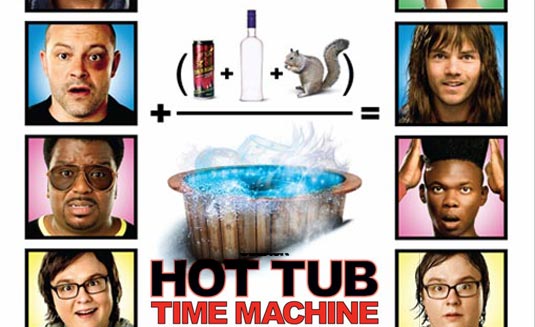
 Date Night also posits a married couple in danger, though this time the couple aren’t newlyweds (they have two kids that won’t let them have sex). It’s basically the same idea as Woody Allen’s Manhattan Murder Mystery in which a couple’s marriage has turned uninteresting and boring until they become involved in some dirty dealings and find their lives in danger. It’s true that Date Night doesn’t come up to Manhattan Murder Mystery’s level (Allen’s characters are a bit more interesting and the way the story unfolds is a bit more clever), but at the same time I feel that Date Night has gotten a bad rap from the reviewers. It’s not the greatest thing since sliced bread, true, but it’s also a perfectly entertaining piece of fluff and one could probably do worse with very little effort. The main charm of the movie comes from Steve Carell and Tina Fey who have great chemistry together and really feel, as my friend said who accompanied me, as if they are a true married couple. They have the ability to barely move the corners of their mouths and say millions, and the twinkle in their eyes don’t hurt. Their characters have reached a crisis point in their marriage: it’s become boring and even worse, they’re too tired to have sex. They each desperately want their marriage to work, but don’t know what to do about it and are too scared to bring the subject up for fear that would only make things worse. So they go on a date into the big bad city of Manhattan and pretend to be someone else in order to get a table at a restaurant (apparently a worse crime than killing someone these days—it’s a nice little reoccurring gag). But the people they are pretending to be turn out to be involved in a blackmail scheme involving Mafiaso Ray Liotta (no surprise there) and corrupt DA William Fichtner. In the end, the couple kind of decides that maybe it’s best to be boring, banal and settled. The movie never rises above what it is, puffy entertainment, with a script (by Josh Klausner) and direction (by Shawn Levy) that gets the job done, but little more. But it’s certainly as good as Hot Tub Time Machine with the added advantage of being funny without being afraid of strong women or homosexuality: Carrell is manly and secure enough in his sexuality to admit that Marc Wahlberg’s pecs even turn him on.