About Me
- Howard Casner
- PLEASE NOTE: I have moved my blog to http://howardcasner.wordpress.com/. Please follow the link for all my updated postings. Thank you.
Showing posts with label Meryl Streep. Show all posts
Showing posts with label Meryl Streep. Show all posts
Saturday, February 4, 2012


Sunday, December 27, 2009
THERE’S COMPLICATED AND THEN THERE’S COMPLICATED: Reviews of It’s Complicated and Sherlock Holmes
 In It’s Complicated, the author Nancy Meyers (who also directed) constantly uses the idea of French films as a metaphor for what is happening in her story. And she’s exactly right. The pitch line for this movie, a woman has an affair with her ex-husband who left her for a younger woman years earlier, is exactly the sort of thing the French, with their “oh, so adult” sense of relationships, would do. It would star someone like Catherine Deneuve as the wife and people like Daniel Auteuil and Gerard Depardieu as the ex-husband and the new boyfriend. It’s hard to say that the French would do it better; they have their hits and misses. But for me, It’s Complicated never does quite rise to its sophisticated occasion. Everyone works very hard, especially Meryl Streep as the wife who has become the other woman. She’s constantly laughing or flailing her arms or rolling her eyes; if a line isn’t working, then her body sure is. Alec Baldwin probably gives the best line readings of the leads, he seems so relaxed, though Steve Martin has some wonderful scenes being stoned. In the end, however, it’s John Krasinski as Streep’s future son in law who has the best double takes and gets the most laughs. It’s hard to say exactly why it doesn’t work as well as one would want. It has all the right ingredients. But perhaps the clever script isn’t quite clever enough and perhaps Meyers doesn’t quite have the right Gallic touch for the material. Perhaps Streep’s friends and her children are just a bit too much of a drag. Perhaps everybody’s just trying too hard. Perhaps, perhaps, perhaps. I don’t know. It’s complicated.
 Sherlock Holmes may on the surface be about the famous Victorian detective, but the movie, or at least the best parts of it, are about a straight married couple (Holmes and Watson) going through a divorce made all the more difficult because one is marrying someone else and the two are still in love with each other. Gee, this sounds awfully like the movie It’s Complicated. It’s not, though I would have to say that in many ways calling the plot to Sherlock Holmes complicated might be a very apt description. This was the part of the movie that didn’t really work that much for me. The evil plan put forth by Mark Strong’s Lord Blackwood has something to do with destroying both houses of Parliament with the eventual idea of taking back the American colonies which have been weakened by the Civil War. His ultimate goal is world domination, but exactly how reclaiming the United States would help him do just that is somewhat unclear, and therefore just a tad on the camp side (sort of like Lex Luther wanting to cause an earthquake and have California slip back in the ocean so all his new property will be beach front—actually that makes a little more sense). It also depends not so much on cleverness on Blackwood’s part, but on such dull plot twists as his taking the easy way out and bribing some jail keepers. But no matter; Blackwood’s plan may be a tad confusing, but the love spats of Holmes and Watson (played wonderfully by Robert Downey, Jr. and Jude Law) are very clear indeed. Eddie Marsan (having a good couple of years) also works well as Inspector Lastrade, but Rachel McAdams doesn’t really strike the right cord as a femme fatale, though it is fun to see how shy and uncomfortable Holmes gets around women. It’s heavily directed by Guy Ritchie, which works part of the time, but at others, gets a bit in the way. The uneven script is by Michael Robert Johnson, Anthony Peckham and Simon Kinberg. It’s not a disaster, but not as good as it could have been.
Saturday, December 5, 2009
CALL OF THE WILDS: Reviews of Where the Wild Things Are and The Fantastic Mr. Fox
 Where the Wild Things Are had to grow on me. It wasn’t until about halfway through that I finally figured out what it was about: a character study of a young boy with a classic case of serotonin deprived depression. Max Records plays Max (well, wasn’t that convenient), a young boy with wild mood swings of grandiose highs and debilitating lows, all out of proportion to the circumstances surrounding him, though those circumstances (he’s new to a neighborhood; no friend; child of divorce; a sister too much older than him to find him nothing but an annoyance; his mother has a new boyfriend) do add to his problematic situation. His mother, played excellently as usual by Catherine Keener, doesn’t really understand what’s going on nor has the time to figure it out. After a particularly egregious tantrum, Max runs away, finds a boat and sails to an island of gigantic and somewhat weird puppet/animal like creatures, strongly voiced by such actors as James Gandolfini, Catherine O’Hara and Forest Whitaker. The film began working for me when I realized that these creatures all had similar, though even deeper and more irrational, emotional problems than Max. For the first time, Max gets to see himself as other people see him. He returns home, but it’s unclear whether this adventure has really helped him. The creatures are wonderfully animated, especially the mouths, and the music and songs are heaps of fun. The main drawback may be Spike Jonze (who co-wrote the screenplay with Dave Eggers) who directs the piece as if he were Paul Greenglass doing a Bourne film. I found myself at times trying to fill in the blanks because Jonze had a yen for using jump cuts. But by the time it was all over, I was moved.
 The Fantastic Mr. Fox is well…fabulous (bet you thought I was going to say “fantastic”, didn’t you; please, it would be so obvious to include that word in this review). It’s as clever and fun and quirky as Babe, which is saying quite a bit. There is one rather odd aspect to it. Fox and his friends are animals who can walk, talk, reason, etc., basically humans in animal bodies. But they feed on other animals, like chickens, geese, turkeys, etc. This is rather creepy and almost comes across as cannibalism; it’s actually borderline disturbing. Of course, if one realizes that the original story is by Roald Dahl, whose stories always did have a unique and somewhat creepy aspect to them, I suppose it shouldn’t be very surprising that this isn’t your typical everyday children’s film. The suave and debonair Fox is played by the suave and debonair George Clooney. He’s actually a character I would have little to do with in real life since he’s so incredibly vain and egocentric, running roughshod over everybody else, doing whatever he wants to do when he wants to do it and if anybody else has a problem with that, too bad (he’s also pretty rotten to his son). However, that is one of the great things about art—one can spend quality time with someone one would never have anything to do with in real life from the safety of a movie seat. His longer suffering wife is played by Meryl Streep (that makes three films in one year for both of them--aren't they the busy little bees) with an appropriately long suffering voice. The screenplay (by director Wes Anderson and the tres droll Noah—Squid and the Whale—Baumbach) is witty, energetic and never runs out of cleverness. The direction by Wes Anderson is ever so much the same; no scene is complete with some extra bit of visual manipulation that just gives it that something…well, extra, to make it memorable. The animation is remarkable, down to the moving hairs on the characters' face. It’s what is called sophisticated and adult; the question then is whether it will sell in the multiplex. One can only hope.
Monday, August 24, 2009
A WOMAN'S PLACE: Reviews of A Woman in Berlin and Julie & Julia
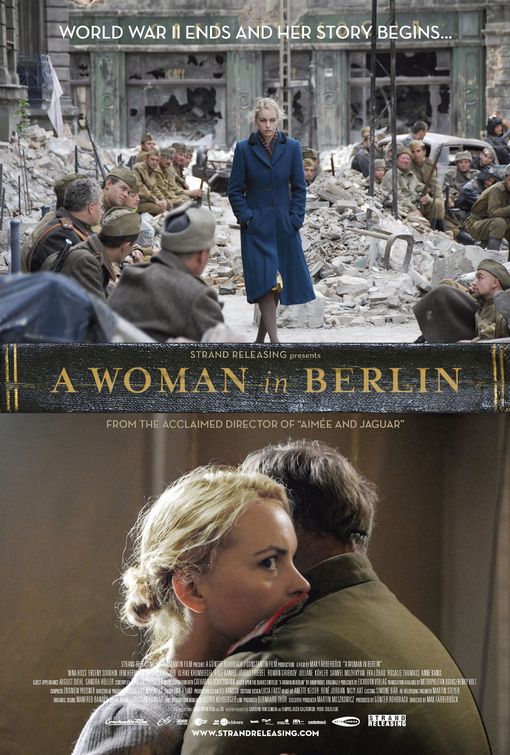 A Woman in Berlin is hardly what the previews prepare one for. The coming attractions suggest a hard hitting expose, ripped from the headlines type movie about a sordid bit of WWII history, a story that has been more or less ignored in histories of the time: the rapacious use of women when the Russians marched into Berlin at the end of the war. It’s not that it’s not about that, but in reality, this awful situation is really more the backbone of the story rather than the gist of it. For when all is said and done, this is really an old fashioned 1930’s star crossed romance. I may get in trouble for saying something as outrageously inhumane as this (of course, no one really reads this blog, so who’s going to know), but it’s the type of movie that once upon a time would have starred Greta Garbo or Marlene Dietrich with Adolphe Menjou, at his oily best, as the man she gives herself to in order to survive; her husband would have been played by an nonthreatening leading man like Herbert Marshall. It’s one of these new movies (like Blackbook and Flame and Citron) which is suppose to be a revisionist look at the morality of WWII where we are asked to reconsider the idea of bad guys and good guys. This is a perfectly acceptable idea, but the revisionism is a bit hunt and peck in this movie as written by the director Max Farberbock and co-writer Catharina Schuchmann. Though a couple of atrocities committed against the Russians are mentioned in passing, one would never know that six million Jews died at the hands of the German (one wants to muddy the waters, but not muddy them too much it seems). In spite of all this, there is much worth seeing here. The subject matter is important and the leading lady is German actress of the moment, Nina (Yella, Jericho) Hoss. And the fate of the star crossed lovers at the heart of it does leave one with a tear in the eye.
 Julie & Julia is that movie about Julia Child and another real person that isn’t as famous. I could repeat the usual analysis of it in which people point out the story line with Julia Child (brilliantly portrayed by Meryl Streep; poor girl, she actually has to go to the Oscars again) is great, but the part with Amy Adams, a good actress stuck with a dull, uninteresting character, isn’t so much so (it’s even hard to understand, based on the excerpts read aloud in the movie, why anybody even read her blog). Instead I’ll focus on an odd through line that I found somewhat disturbing. For a movie that has two women as central characters, the movie as a whole doesn’t have much positive to say about women as a whole. In the screenplay by director Nora Ephron, there are two kinds of women. There are the friends of Julie, high powered businesswomen played at the height of soullessness in their best Faye Dunaway/Diane Christiansen manner by an assortment of actors. They’re the bane of Julie’s existence and ridiculed mercilessly by Ephron. The other kind of women, the ones that Ephron seems to approve of, are nonthreatening, never even considering doing a man’s job. For Julia, it’s to take a cooking class without the goal of becoming of chef and then writing a cook book; for Julie, it’s writing a blog about cooking and then writing books. Nice, safe womanly things to do (even in Julia’s world, the male chefs are accepting and encouraging, it’s the female who runs the cooking school herself who is the gorgon). Though on the outside this movie would seem to be an antidote to the misogynistic turn of romantic comedies like The Proposal and The Ugly Truth, once the surface is scraped away, it’s not really that much different.
Subscribe to:
Posts (Atom)


