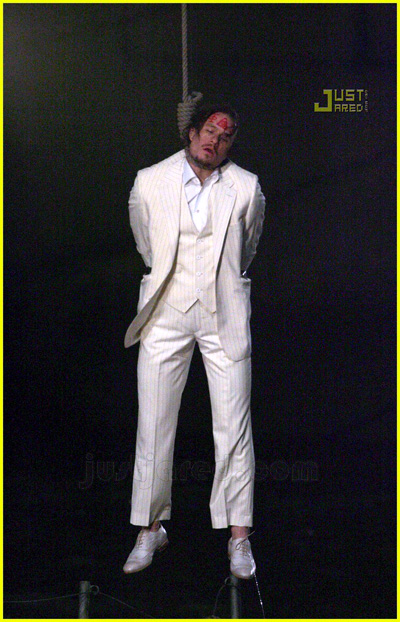
Cloud Atlas
the movie stars Frank Griebe and John Toll as the Cinematographers; Huge Bateup
and Uli Hanisch as the Production Designers; Rebecca Alleway and Peter Walpole
as the Set Designers; Kym Barett and Pierre-Yves Gayraud as the Costume
Designers; and a cast of thousands when it comes to Makeup and Art Direction. There are also some actors involved, but
they’re all pretty much chopped liver by the time the credits roll.
The movie,
for those not on twitter and facebook, contains six story lines set in six
different periods of time, including the future as well as the future
future. The basic themes seem to be that
we’re all connected; everything that happens is cause and effect; and that the
flapping of a butterfly’s wings in Kansas
can cause a tsunami in Japan. Except it’s not really.
In fact, as
the movie jumps from time period to time period and story to story (as a friend
of a friend said, it’s the perfect movie for those with ADD), no one character
or event in one time period has any affect on any character or event in another
time period. Or if they did, the writers (those V for
Vendetta/Matrix welding Wachowski siblings, Lana and Andy, as well as Tom, Run
Lola Run, Twyker, all of whom also directed) did a very good job of keeping it
to themselves. True, there are overlaps. A book from one period, letters from another,
a piece of middle brow music that people go gaga over for some unclear reason,
all end up in another era. But that’s
not a connection. That’s a coincidence. And of the extremely forced variety. Coincidence and connection are not the same
thing, no matter how much new age mumbo jumbo you want to throw at it. Or if it is, the filmmakers have a totally
different understanding of butterflies and tsunamis that I do (which is more
than quite possible).
In the end,
there’s only one reason to have made this movie and that is the opportunity to
do a tour de force thingy by creating six difference films in six different
styles (Bladerunner, Brideshead Revisited/Merchant-Ivory, a 1970’s crime drama
cum social ills action movie, etc.), all using the same set of actors. And if the filmmakers had pulled that off,
what an amazing film it would have been.
But alas, the
only section that really hits its mark is the Bladerunner type story about
replicants in a futuristic New Seoul.
This story has the best acting (Jim Sturgess and Doona Bae in the
leads); it hits its emotional mark of doomed lovers on the run (a 22nd
Century take on They Live By Night); and the visual aspects of this section
meld well and don’t overpower the human (well, replicant, but let’s not be
petty) element. For the other sections,
the filmmakers can’t seem to get the styles or rhythms quite right with the story
set further in the future almost impossible to follow.
And then
there’s the acting. The biggest names
are Tom Hanks, Susan Sarandon and Hallie Berry. Sarandon isn’t given much to do. Hallie Berry
comes across well enough, especially in the 1970’s action film; all in all, her
roles don’t require a great range (and there seem to be little difference in
her ambitious investigative reporter and futuristic alien). But (to paraphrase Pauline Kael in talking
about Norma Shearer) oh, that Hanks.
Perhaps because he is so recognizable no matter what thickness of make
up and prosthetics are slathered on, he felt the need to overplay every role to
really remind people that he really isn’t who you think he is—but the further
he tried to get away from himself, the closer he got.
The best performers
come from the younger generation, like Sturgess and Bae as well as Ben Whishaw,
the perpetually pouting English actor with the big hair. They seem a bit more comfortable playing
their wide range of roles (though the make up for Bae lets her down in the
anti-slavery tract section). And Hugo
Weaving is a hoot in his Nurse Diesel/Ratchett turn, this time named Nurse
Noakes (but he had a lot of practice in Priscilla, Queen of the Desert).
In the end,
Cloud Atlas is ambitious and often overpowering to look at. But in execution, to be cruel and ruthlessly
honest, it comes across more as the perfect choice for bad movie night where
everyone can yell out comments as the scenes go by. One suggestion: in the 1970’s film, when
Hanks, coiffed in the typical top and sideburns of the day, and Berry
go outside and Berry asks if it’s
okay to smoke and Hanks says, I’m cool—yell out, not with that hairstyle,
you’re not.