About Me

My photo
PLEASE NOTE: I have moved my blog to http://howardcasner.wordpress.com/. Please follow the link for all my updated postings. Thank you.
Showing posts with label Tom Hanks. Show all posts

Tuesday, November 13, 2012

CLOUD ATLAS


Cloud Atlas the movie stars Frank Griebe and John Toll as the Cinematographers; Huge Bateup and Uli Hanisch as the Production Designers; Rebecca Alleway and Peter Walpole as the Set Designers; Kym Barett and Pierre-Yves Gayraud as the Costume Designers; and a cast of thousands when it comes to Makeup and Art Direction.  There are also some actors involved, but they’re all pretty much chopped liver by the time the credits roll.

The movie, for those not on twitter and facebook, contains six story lines set in six different periods of time, including the future as well as the future future.  The basic themes seem to be that we’re all connected; everything that happens is cause and effect; and that the flapping of a butterfly’s wings in Kansas can cause a tsunami in Japan.  Except it’s not really. 

In fact, as the movie jumps from time period to time period and story to story (as a friend of a friend said, it’s the perfect movie for those with ADD), no one character or event in one time period has any affect on any character or event in another time period.   Or if they did, the writers (those V for Vendetta/Matrix welding Wachowski siblings, Lana and Andy, as well as Tom, Run Lola Run, Twyker, all of whom also directed) did a very good job of keeping it to themselves.   True, there are overlaps.  A book from one period, letters from another, a piece of middle brow music that people go gaga over for some unclear reason, all end up in another era.  But that’s not a connection.  That’s a coincidence.  And of the extremely forced variety.   Coincidence and connection are not the same thing, no matter how much new age mumbo jumbo you want to throw at it.  Or if it is, the filmmakers have a totally different understanding of butterflies and tsunamis that I do (which is more than quite possible).

In the end, there’s only one reason to have made this movie and that is the opportunity to do a tour de force thingy by creating six difference films in six different styles (Bladerunner, Brideshead Revisited/Merchant-Ivory, a 1970’s crime drama cum social ills action movie, etc.), all using the same set of actors.  And if the filmmakers had pulled that off, what an amazing film it would have been.

But alas, the only section that really hits its mark is the Bladerunner type story about replicants in a futuristic New Seoul.  This story has the best acting (Jim Sturgess and Doona Bae in the leads); it hits its emotional mark of doomed lovers on the run (a 22nd Century take on They Live By Night); and the visual aspects of this section meld well and don’t overpower the human (well, replicant, but let’s not be petty) element.  For the other sections, the filmmakers can’t seem to get the styles or rhythms quite right with the story set further in the future almost impossible to follow.

And then there’s the acting.  The biggest names are Tom Hanks, Susan Sarandon and Hallie Berry.  Sarandon isn’t given much to do.  Hallie Berry comes across well enough, especially in the 1970’s action film; all in all, her roles don’t require a great range (and there seem to be little difference in her ambitious investigative reporter and futuristic alien).  But (to paraphrase Pauline Kael in talking about Norma Shearer) oh, that Hanks.  Perhaps because he is so recognizable no matter what thickness of make up and prosthetics are slathered on, he felt the need to overplay every role to really remind people that he really isn’t who you think he is—but the further he tried to get away from himself, the closer he got.

The best performers come from the younger generation, like Sturgess and Bae as well as Ben Whishaw, the perpetually pouting English actor with the big hair.  They seem a bit more comfortable playing their wide range of roles (though the make up for Bae lets her down in the anti-slavery tract section).  And Hugo Weaving is a hoot in his Nurse Diesel/Ratchett turn, this time named Nurse Noakes (but he had a lot of practice in Priscilla, Queen of the Desert).

In the end, Cloud Atlas is ambitious and often overpowering to look at.  But in execution, to be cruel and ruthlessly honest, it comes across more as the perfect choice for bad movie night where everyone can yell out comments as the scenes go by.  One suggestion: in the 1970’s film, when Hanks, coiffed in the typical top and sideburns of the day, and Berry go outside and Berry asks if it’s okay to smoke and Hanks says, I’m cool—yell out, not with that hairstyle, you’re not.

Sunday, May 31, 2009

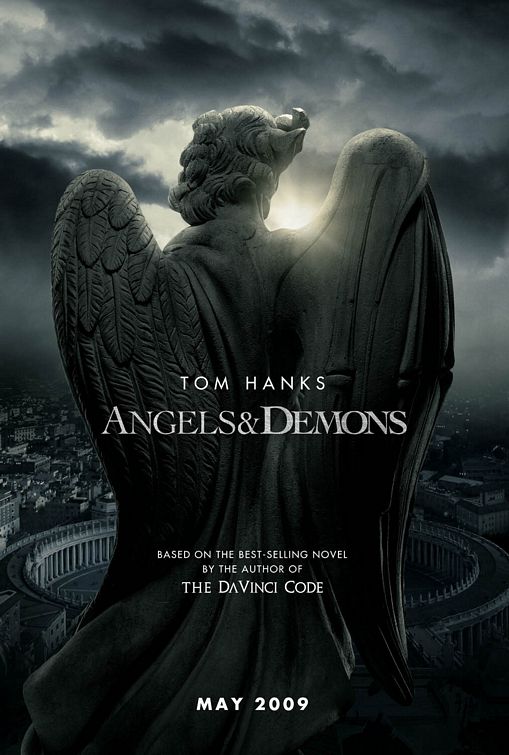
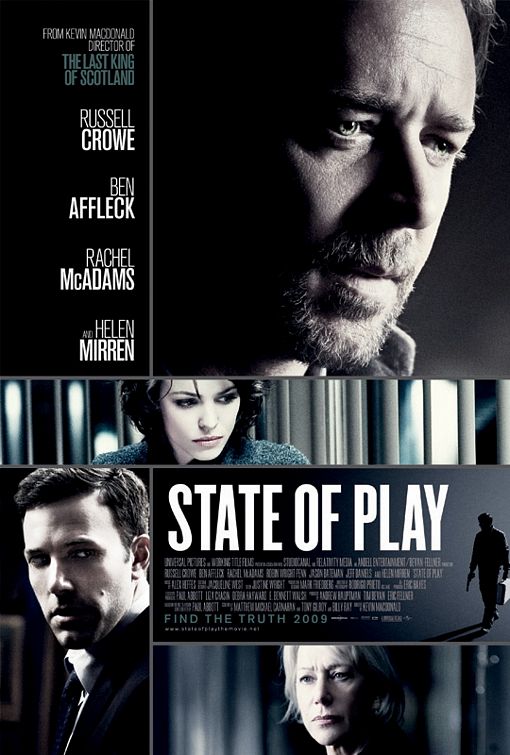
MYSTERIES BOTH SECULAR AND DIVINE: Reviews of Angels and Demons and State of Play

The producers, director, and writers would have you believe that the intended audience for Angels & Demons are those who find religious issues to be of interest. But in reality, the actual audience for this movie are people who like crossword puzzles, anagrams and other word games. The real theme of the movie is not whether science and religion can be reconciled (in fact, whenever the dialog drifts to rel v. sci it all gets pretty silly), it’s what does this clue; that word hideously branded into a cardinal’s chest; that dead body mutilated and murdered in that way mean, and how will it lead Tom Hanks to what obscure bit of art history that will lead him to the bad guy. Angels and Demons is a perfectly acceptable suspense thriller that is actually very entertaining until the ending whereupon we are blessed (blessed, get it?, get it?) with one of those twists that renders everything that has come before it ridiculously unbelievable. The acting is perfectly fine with Stellan Skarsgard taking the honors. However, the real standout performance is the incredible recreation of the Vatican. The low point of the film is Armin Mueller-Stahl’s last line which is a paraphrase of Deborah Kerr’s final words in Tea and Sympathy (where she tells a teenager she is about to deflower “Years from now, when you talk about this, and you will…be kind”). It’s simply too close not to believe that someone didn’t know.

I consider the original version of State of Play to be one of the great mini series in TV history. So I was quite surprised at how much I enjoyed the movie version. The main reason it worked as well as it did for me was that the authors (screenplay by Matthew Michael Carnahan, Tony Gillroy and Billy Ray) found an absolutely brilliant American parallel scandal to put at the heart of the drama, an attempt by a Big Brother type company to win a government contract to take over domestic spying. And whenever the movie focuses on the central mystery of how two apparently unrelated deaths are intrinsically linked, it’s riveting (the direction by Kevin McDonald is quite satisfactory). It falters when it comes to characterization. Russell Crowe plays one of those scruffy reporters who always looks like he just got out of bed; you know, the kind who don’t play by the rules, but we forgive him because he brings down people like Nixon? The character’s a cliché and if he’s not a stereotype, he should be. The up and coming blogger is played by Rachel McAdams and she has no real character whatsoever; she’s a less developed version of one of those Dirty Harry sidekicks, though in this movie she’s allowed a better fate. The little tete a tetes the two have over the old journalism versus the new journalism never catch fire because the dialogue is the same paint by numbers argument that comes up whenever any new technology is introduced, the old “mark my words, the introduction of sound will be the death of the movies” type stuff. The acting honors are taken by Helen Mirren as the hard as nails editor and Justin Bateman as a slimy bisexual lobbyist. Ben Affleck is becoming more and more interesting as he seems to be taking a page from the Matt Damon play book: be an ensemble player rather than a star. All in all, a fun ride.

Wednesday, March 25, 2009

Reviews of Sunshine Cleaning and The Great Buck Howard


Sunshine Cleaning is a movie about estranged sisters who bond after starting a business cleaning up crime scenes. It’s one of those formulaic films that have been the basis of American movies since the dawn of silents: someone goes on a three act journey and has a character arc change by the end. As such, the movie is obvious and takes no real chances. At the same time, the script is intelligent and well written (by Megan Holley) with some moving moments and it’s doubtful the audience will be disappointed. It also has some fine acting, especially by Amy Adams and Emily Blunt as the sisters and a fine supporting cast of Alan Arkin, Steve Zahn and Clifton Collins, Jr. In the end, it doesn’t quite work as well as it should because the gimmick, the cleaning service, actually overshadows and distracts from the hero’s journey rather than really informs it. The sisters bond more in spite of it all rather than because of it. And there’s one scene, where Amy Adams attends a baby shower, that doesn’t have a strong enough pay off and falls flat. It probably doesn’t help that she has a big speech about what she’s gotten out of cleaning up crime scenes when in reality it’s Blunt who is the one who has come to realize what Adams has supposedly, but not really, learned here.

The Great Buck Howard also has Emily Blunt and Steve Zahn (though this time Zahn is playing the typical Steve Zahn role, complete with unflattering mullet). Like Sunshine Cleaners, it’s also formulaic as well as entertaining and intelligently written (this time by Sean McGinly, who also directed). In it, a man played by Colin Hanks, leaves law school in a huff and against the wishes and knowledge of his authoritarian father (play by Hanks’ real life father, Tom Hanks, who probably isn’t as authoritarian as his character or Colin would probably have never entered show business). In the end, …Buck Howard works better than Sunshine Cleaning because the gimmick here, an over the top character based on the real life over the top mentalist Kreskin, is more central to Hanks’ character arc and provides an ending that is wittier and cleverer than Sunshine Cleaning’s. It’s also buoyed by a delicious performance by John Malkovich as Howard and an equally delicious performance by Tom Hanks playing an unsympathetic character, something he’s actually very good at and the kind of role he hasn’t really played since perhaps That Thing You Do. It’s nice to know that if the public grows tired of Hanks being cast because he’s instantly likeable, he can always take a page from Alan Alda’s page book and revive his career by playing assholes.